
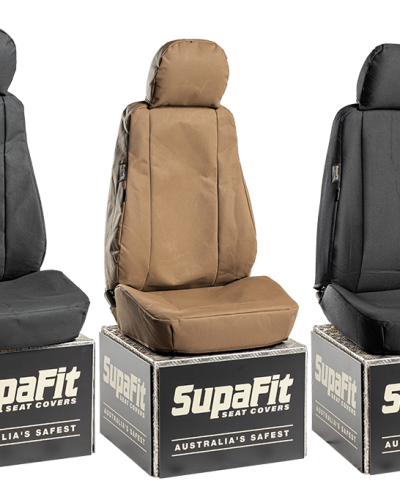
If you have searched for seat covers for more than five minutes, you have hit the same wall. Neoprene, canvas or denim? Every brand says theirs is best. Here is the unbranded version.
The quick comparison: choosing the best seat cover material
| Feature | Canvas | Denim | Neoprene |
| Waterproofing | 100% waterproof | Protects against dust and dirt, not fully waterproof | Water resistant, closed cell foam |
| Feel | Rugged, coarse weave | Soft, cooler to the touch | Thick, foam backed, insulating |
| Heat in summer | Does not hold heat the way foam does | Cotton outer, cooler to the touch | Foam core retains heat, can feel warm in direct sun |
| Best suited to | Tradies, 4WDs, worksites, dogs and tools | Family vehicles, dealership presentation, fleets wanting comfort with durability | Watersports and wetsuit-style use, where waterproofing matters more than breathability |
Canvas: built to survive whatever you throw at it
Canvas from SupaFit Seat Covers is a 14.9 oz coarse weave, medium weight fabric, blended with polyester for extra tear strength. It is 100% waterproof, UV stabilised, and resistant to mould, mildew and bacteria. If your vehicle sees mud, dogs, tools or a genuine worksite, canvas is built to take it and keep taking it.
Denim: comfort without giving up protection
Denim from SupaFit Seat Covers is a cotton twill outer, laminated with a high density 6 mm foam backing. It is softer and cooler to the touch than canvas, and still gives full protection from dust and dirt. It suits family vehicles and dealership demonstrators where presentation matters as much as protection.
Neoprene: why SupaFit does not make it
Neoprene is the wetsuit material, a closed cell foam rubber that is genuinely excellent at keeping water out. That is exactly why it works for watersports gear. But the same foam core is a poor match for a daily driven vehicle seat in this climate:
- Heat retention: Neoprene’s foam backing insulates rather than dissipating heat, so it holds warmth against the seat in direct sun. In an Australian summer, that is the difference you feel first.
- New cover odour: Neoprene covers can carry a rubber smell when new. It usually fades with airing out, but it is worth knowing before you buy.
None of that makes neoprene a bad material. It is the right choice for a boat seat or a wetsuit. It is just the wrong trade-off for a 4WD, ute or family car that spends its life in the sun. That is a deliberate decision at SupaFit Seat Covers – not a gap in the range.
What happens to heated and ventilated seats?
Every backed seat cover sits between you and the heating element, reducing airflow on ventilated seats. If your vehicle has factory seat heating or ventilation and you use it, raise that when you enquire rather than assuming any cover will pass it through. It is a real trade-off and worth a conversation, not a line of fine print.
Airbag compatibility, regardless of fabric
Whichever fabric you choose, airbag compatibility is not optional. Canvas and denim covers from SupaFit Seat Covers both use SupaSeam, a documented, computer controlled seam aligned to your vehicle’s side airbag position, independently tested against ADR72/00 by NATA-accredited laboratories. If you are comparing brands, ask specifically what standard the seam is tested to and who certified it, before you buy.
Forget universal fit compromises. Every set is cut to your vehicle’s make, model, build year and seat configuration, then hand-sewn to order in Welshpool, Western Australia. Send your make, model and year and SupaFit Seat Covers handles the precision from there.